The Kitchen Knife Care Guide: Keep Your Edge for Years
Honing is not sharpening, glass boards are edge killers, and the dishwasher is off limits. Everything you need to keep your knives sharp and safe.
 By Priya Hollis
April 29, 2026 · 5 min read
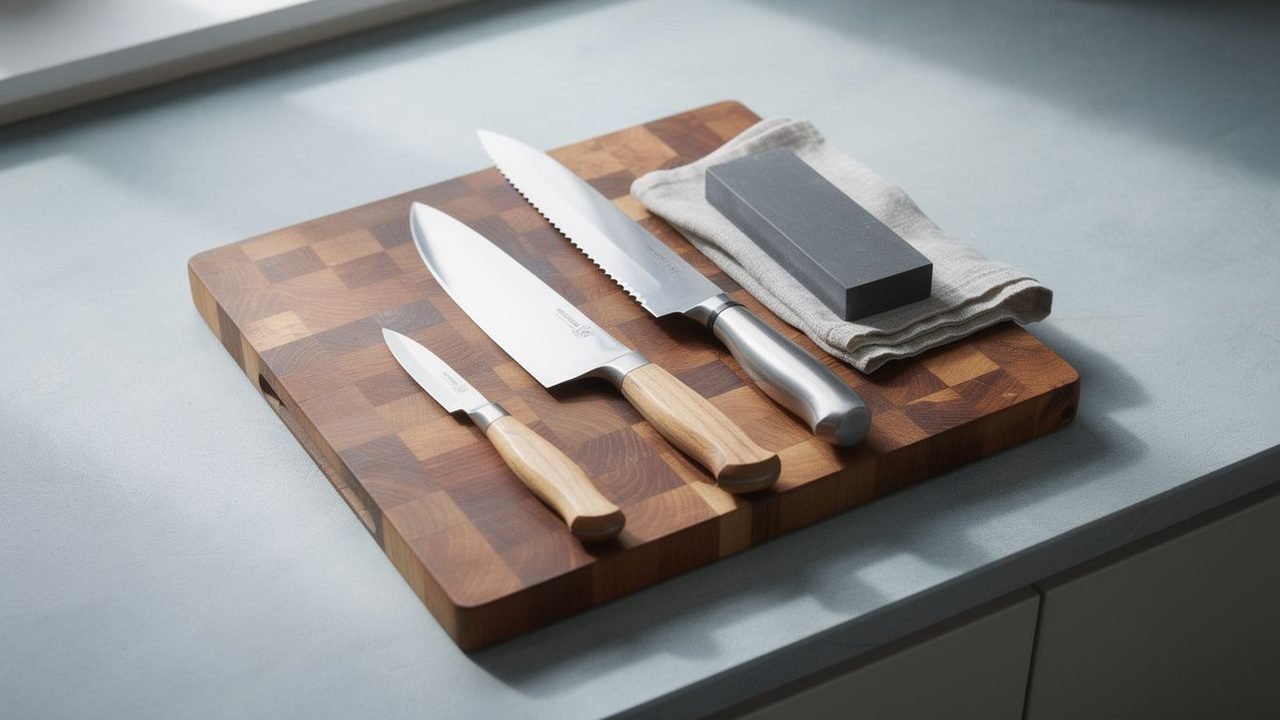
A sharp knife is the most important tool in any kitchen. It makes prep faster, gives you cleaner cuts, and is actually safer than a dull one, because it goes where you guide it instead of slipping off the skin of a tomato. Keeping a knife sharp is less about expensive equipment and more about a few habits. Here is how to care for your knives from everyday use to long-term maintenance.
Honing vs. sharpening
These two words get used interchangeably, but they are different jobs.
- Honing realigns the edge. With use, the very thin edge of a blade bends and rolls slightly to one side. It still has metal there, but it is no longer pointing straight. A honing rod pushes it back into line. Honing removes little or no metal, and you can do it often.
- Sharpening removes metal to create a fresh edge. You need it when honing no longer brings the knife back. For most home cooks, that means a few times a year, depending on how much you cook.
If your knife feels dull, try honing first. You may be surprised how often that is all it needs.
How to hone a knife
- Hold the honing rod vertically with the tip resting on a folded towel on the counter.
- Place the heel of the blade against the top of the rod at roughly a 15 to 20 degree angle. Many Western-style knives sit closer to 20 degrees, and many Japanese-style knives closer to 15. Check your knife's guidance if you are unsure.
- Draw the knife down and toward you in a smooth sweep, so the whole edge from heel to tip touches the rod.
- Repeat on the other side of the rod with the other side of the blade.
- Do five to eight light strokes per side. Pressure is not your friend here. Gentle and consistent wins.
Sharpening options
Whetstones
Whetstones give you the most control and the best edge once you have a bit of practice. A combination stone with a medium grit around 1000 and a fine grit around 4000 to 6000 covers most home needs. Soak or splash the stone according to its instructions, hold a consistent angle, and work the edge until you can feel a slight burr along the opposite side. Then switch sides, move to the finer grit, and finish with a few light alternating strokes to remove the burr.
Pull-through and electric sharpeners
These are fast and easy. Quality models do a respectable job for everyday knives, though they typically remove more metal than a stone and offer less control. If you choose one, use light pressure and follow the directions for the number of passes.
Professional sharpening
Many kitchen stores and local knife shops offer sharpening services. Once or twice a year, a professional edge is a great reset, especially for knives with chips.
Cutting boards matter more than you think
The surface you cut on has a huge effect on how long your edge lasts.
- Best: wood, especially end-grain boards, and softer plastic or composite boards. They have a little give, which protects the edge.
- Avoid: glass, marble, granite, slate, and ceramic. These surfaces are harder than your knife and will dull or chip the edge quickly. Save them for serving.
Put a damp paper towel or a thin non-slip mat under your board so it does not slide while you work.
Washing and drying
- Hand wash only. The dishwasher bangs knives against other items, exposes them to harsh detergent and heat, and can damage handles. It is one of the fastest ways to ruin a good knife.
- Wash right after use. Acidic foods like citrus, tomatoes, and onions can stain or pit some steels if left on the blade.
- Wipe from spine to edge. Hold the sponge on the dull spine side and wipe outward, keeping fingers away from the edge.
- Dry immediately. Never leave a knife in a sink full of water, where it can rust and where someone can reach in and get hurt.
Carbon steel knives need a little extra care
Carbon steel blades take a wonderfully keen edge but are prone to rust and discoloration. Dry them thoroughly the moment you finish, and wipe on a very thin coat of food-safe mineral oil before storing if you will not use them for a while. Over time, carbon steel develops a gray or blue patina. That is normal and actually helps protect the blade.
Storing knives safely
Tossing knives in a drawer loose is bad for both edges and fingers. Better options include:
- A knife block: convenient on the counter. Insert knives spine side down if the slots are horizontal, so the edge does not drag.
- A magnetic strip: saves space and keeps knives visible. Place and remove knives spine first to avoid scraping the edge against the magnet.
- An in-drawer organizer or blade guards: great for small kitchens or for knives that travel.
Small habits that protect your edge
- Do not scrape with the edge. When moving chopped food across a board, flip the knife over and use the spine.
- Use the right knife. Do not pry open cans, split frozen food, or hack through bones with a chef's knife. Use a cleaver, kitchen shears, or a bread knife where appropriate.
- Let the knife do the work. Use a smooth slicing motion rather than forcing the blade straight down.
- Hone regularly. A few light strokes before a big prep session keep the edge performing between sharpenings.
A simple test for sharpness
Hold a sheet of printer paper by one corner and slice down through it. A sharp knife glides cleanly. A dull knife snags, tears, or folds the paper. If honing does not fix it, it is time to sharpen.
Treat your knives well and they will return the favor for decades. Few kitchen tools give you so much for so little care.


